When I was younger, I was taught that when Maghrib begins, you must break your fast.
The moment the call to prayer is heard, you eat.
In theory it sounds simple. In practice it often creates complications, especially when you are young and do not fully control your schedule. School, work, transport, and other obligations determine where you are and what you can do.
Some companies try to solve this by allowing Muslim employees to leave work earlier during Ramadan. The intention is good, but it sometimes creates a different problem. It becomes a perceived privilege, and some people start to feel entitled to it.
When I was a student, I would be lying if I said I did not enjoy going home an hour earlier than my non-Muslim classmates.
Years later, during a reservist cycle, I was interviewed by a MINDEF officer who visited our unit in 3 Guards Battalion.
For context, Guards units are not typical infantry units. The standards sit slightly below Commandos but above regular infantry.
At the time I was serving as the Platoon CSM, so the question was directed at me from a leadership perspective.
He asked whether Muslim soldiers fasting should receive concessions, such as reducing physical training or adjusting mission timings to accommodate iftar.
My answer was simple.
Do not give any concessions.
Fasting does not mean we need to reduce physical training or adjust operational timing just to break fast exactly on time.
But I did ask for one thing.
I suggested that one of the rooms in the barracks be converted into a small mussollah so Muslim soldiers could perform their prayers easily when the time came.
That would allow soldiers to fulfill their obligations without disrupting training or operations.
On my next reservist cycle, the room was there.
During my working years I often carried a small packet of dates and a box drink in my bag so I could break my fast wherever I happened to be.
Eventually I stopped doing that. I do not like carrying extra things.
Sometimes I would reach home well after Maghrib because of the commute. I would not even bother stopping somewhere to eat.
To me the thinking was straightforward. I had completed the requirement of fasting for the day. That was enough.
Over time I also trained my body not to depend on eating at a fixed moment.
Many people feel a strong urge to eat the moment Maghrib arrives because their body expects it. Once that habit is broken, the pressure disappears.
The fast ends when Maghrib begins, but eating immediately is recommended, not obligatory.
So if I reach home later, or if I am still in transit, it does not bother me.
I have already completed the fast.
Food can wait. Prayer cannot.
Over time I realized something else. In Islamic law, the obligation of fasting is simply to stop fasting when Maghrib begins. Eating immediately is recommended, but the obligation itself is the end of the fast, not the exact second of eating.
Yet culturally, many Muslims treat breaking the fast at that precise moment as if it were mandatory.
At the same time, I often noticed the opposite attitude toward prayer.
Some Muslims insist strongly that they must break fast exactly at Maghrib. Yet when it comes to daily prayers, many feel comfortable delaying them until the end of their time window.
This is odd, because the discipline around prayer timing is actually stricter than the timing of eating after fasting.
Prayer has defined windows that should not be neglected or pushed carelessly to the last moment.
So there is a strange inversion in practice. Strictness about iftar timing.
Flexibility about prayer timing.
What I eventually practiced was a simple rule.
First, then.
If I know a meeting starts at 2:00 pm, I pray Zuhr before the meeting begins. I do not attend the meeting and hope it ends before Asr arrives.
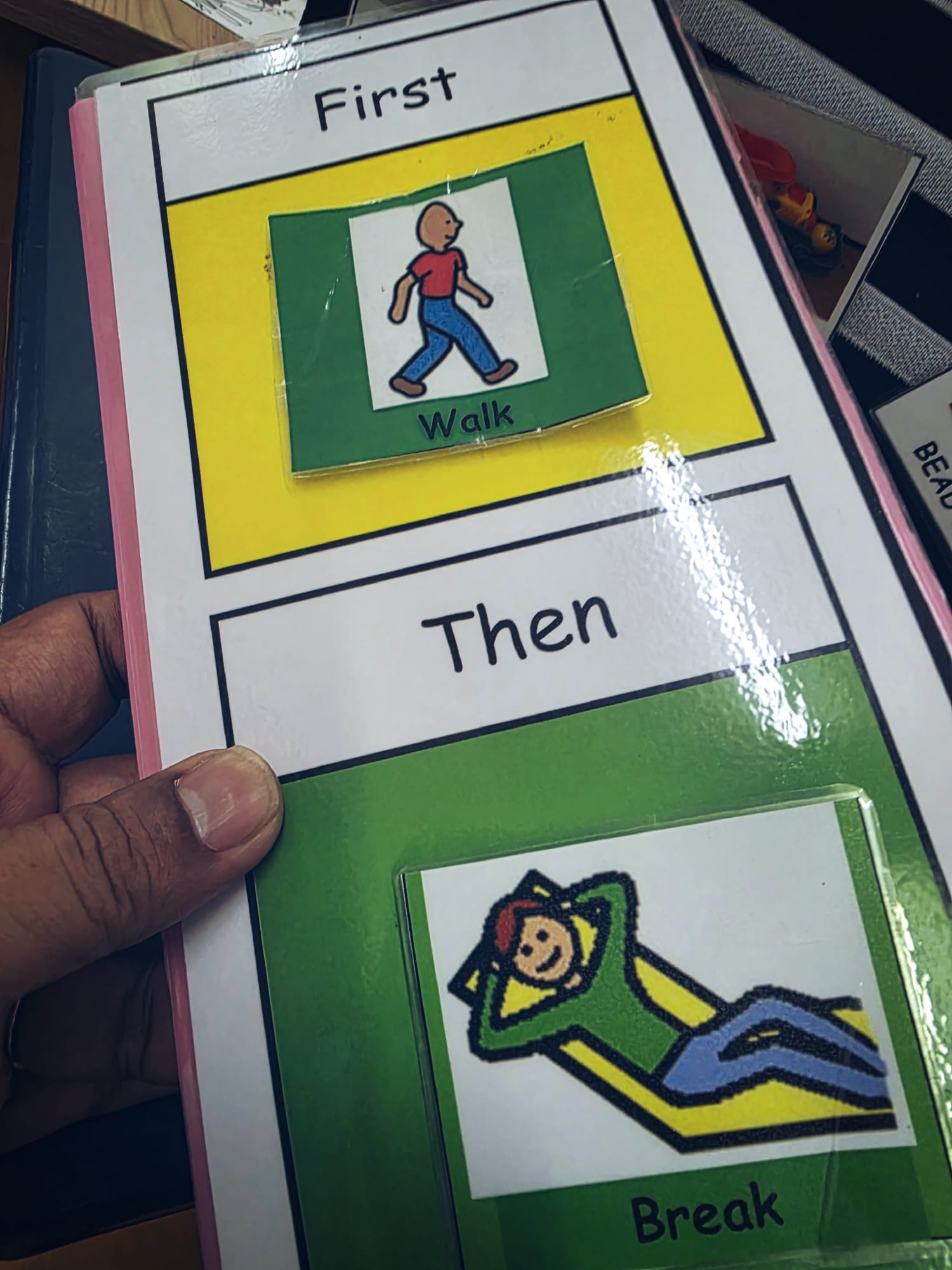
Years later, when I started working with neurodivergent students, especially those on the autism spectrum, I realized something interesting.
One of the teaching tools we use is the same principle.
First, then.
First do this. Then do the next thing.
It creates order and removes unnecessary pressure.
In a way, I had been practicing that idea long before I ever taught it.
Islam already gives us that structure.
First prayer. Then everything else.
And the beauty of it is that prayer does not require a special room or elaborate preparation.
Sometimes, it is simply a quiet moment at your desk.
First, then.